Reading Time: 4 minute
It’s no secret that understanding your visitors is key to learning more about their behavior and turning them into loyal customers.
And the good news for Magento store owners is that the latest version of Google Analytics (GA4) is more powerful than ever to help you make data-driven decisions for your eCommerce store.
Switching to the latest version of Google Analytics gives you better tracking options.
In this blog, learn how to set up Magento 2 GA4 enhanced eCommerce tracking and get practical tips to ensure you get the most out of it!
Read till the end and get a complete picture of:
- What is Enhanced eCommerce Tracking in GA4?
- Options to Set Up Magento 2 GA4 eCommerce Tracking
- How to Set Up GA4 in Magento Store Using Extensions?
- Bonus Tip: Magento 2 GA4 eCommerce Tracking
What is Enhanced eCommerce Tracking in GA4?
Google Analytics 4 is a more data-driven version than previous versions of Universal Analytics, making your reporting process more detail-oriented.
Improved tracking in ecommerce using GA4 offers an extra advantage in understanding your user interactions and creating strategies that move users forward in the sales funnel.
GA4 (Google Analytics 4) follows an event-based tracking approach, which means GA4 records all the events a user completes, giving you, as a Magento store owner, a detailed picture of the user journey, rather than just being at the tip of the iceberg.
As an eCommerce store owner, you need more than just analytical data for your specific product pages or other pages on your website.
For example, for product pages, you need more information about payment options, understand the source of user visits, and track their flow from product discovery to product purchase.
And GA4 can easily pull this kind of advanced information from your site.
Using GA4 for your Magento store:
- You can find out the channel from which the traffic enters.
- Track various events as well as individual events.
- Measure interactions through sessions, engagement metrics and time associated with them.
- You can anticipate user trends by using its predictive metrics.
- You can easily track it user interaction between different devices like website + app.
- Analyze individual users flow and understand closely if there are gaps in the process.
- Get an overview of using it Predictive analytics (GA4 uses machine learning here to provide you with analysis).
Now that we have discussed the importance of GA4 for enhanced eCommerce tracking, let’s discuss the options available for setting up Magento 2 GA4 eCommerce tracking.
Option one: You can add Google Analytics manually
Option two: You can set up GA4 using extensions
Of the two, setting up GA4 using an extension is the preferred option as it not only makes the process easier but also comes with handy features that you can take advantage of.
Here are some of them:
- Offers complete backend control
- Automatically generate JSON for GTM tags and events
- Supports various tracking events
- Track every step of the checkout process
- A codeless way to integrate GA4
How to Set Up GA4 in Magento Store Using Extensions?
Now, let’s get to the interesting part and learn how to set up GA4 using extensions.
Setting up GA4 using extensions is the easiest way to set it up without any hassle. You need to follow a few steps so that GA4 can start tracking your website.
You need two important things before you get started: A Google Tag Manager account and the Google Analytics Magento 2 extension.
Tag Manager Google Account
Here are the steps to create your Google Tag Manager account:
- Create a new account and container
- Assemble the container
- Add tags
- Verify the tag
- Publish tags
Google Analytics Magento 2 Extension
You can use Meetanshi’s Google Analytics Magento 2 extension here. It is a feature-rich extension to track every activity of your users.
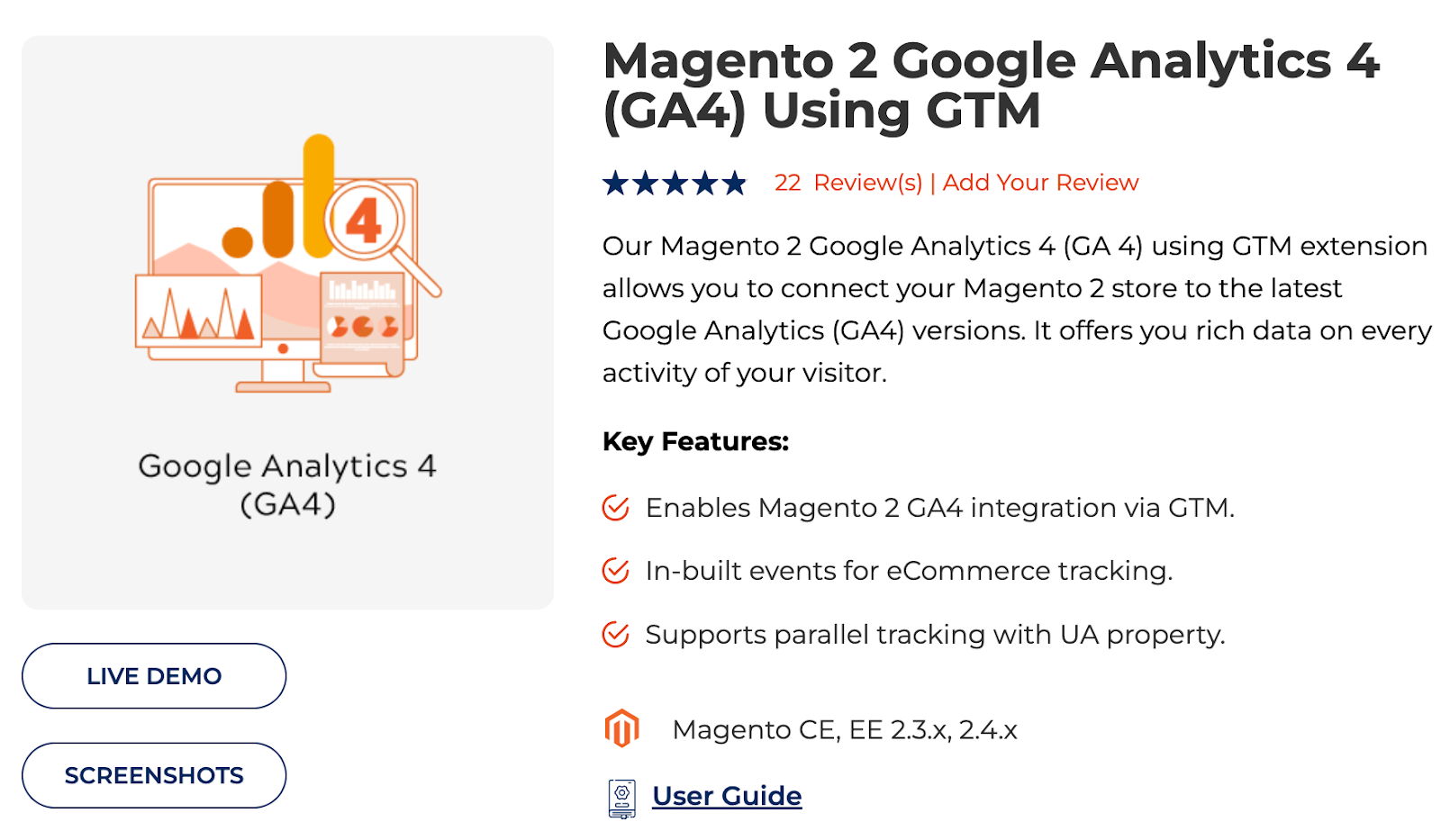
This extension comes with built-in events, performance reports, and extensive support for you to gain meaningful insights into your customer journey.
Additionally, the extension comes with one year of free support and updates.
If you have a GTM account with the right extension, here are the steps to set up Google Analytics 4 on Magento 2 using the extension:
1. Install & Activate Extension
Download and install Magento 2 Google Analytics 4 Meetanshi extension. Once installed, go to Stores > Configuration > Meetanshi > GA4 to activate it.

2. Add GTM Code to Magento 2
Go into your Google Tag Manager and find the Js and non-Js code. Then paste these codes into the respective columns in your Store and click Save.

3. Configure Extensions
Select an element and configure the extension.
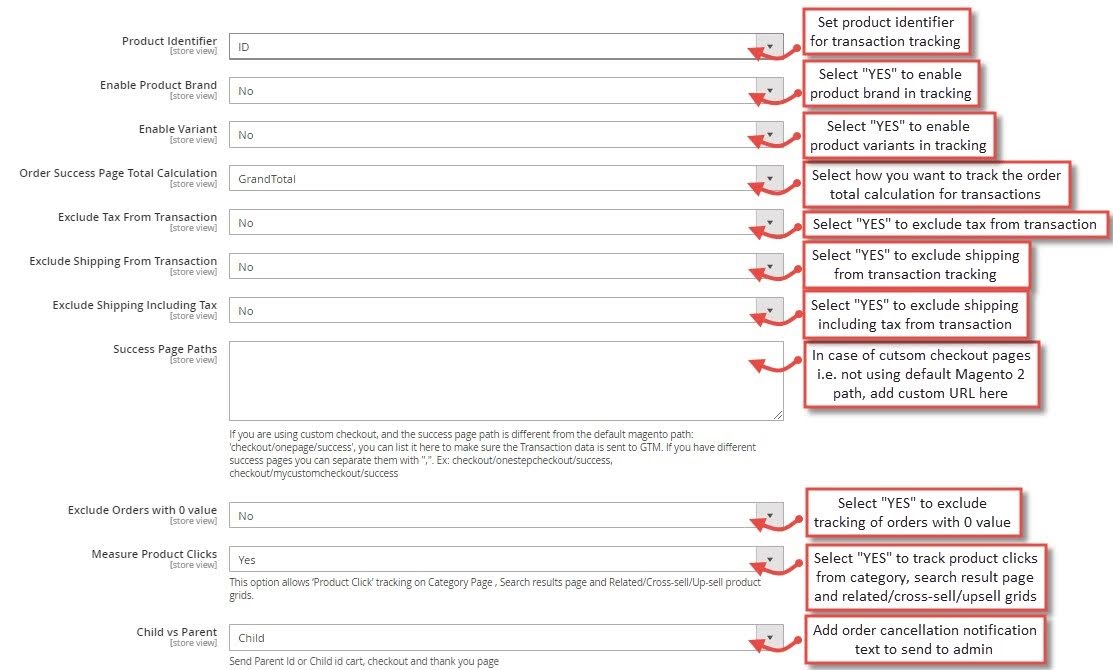
4. Configure Magento 2 GTM API
Get your account ID & container ID from your GTM account, then paste it into your Magento store.

Here, you also need a measurement ID, which you can find in your Google Analytics dashboard. Paste the ID and click Save configuration.
5. Generate & Import JSON to GTM
Generate and download JSON files and submit files to complete the process.
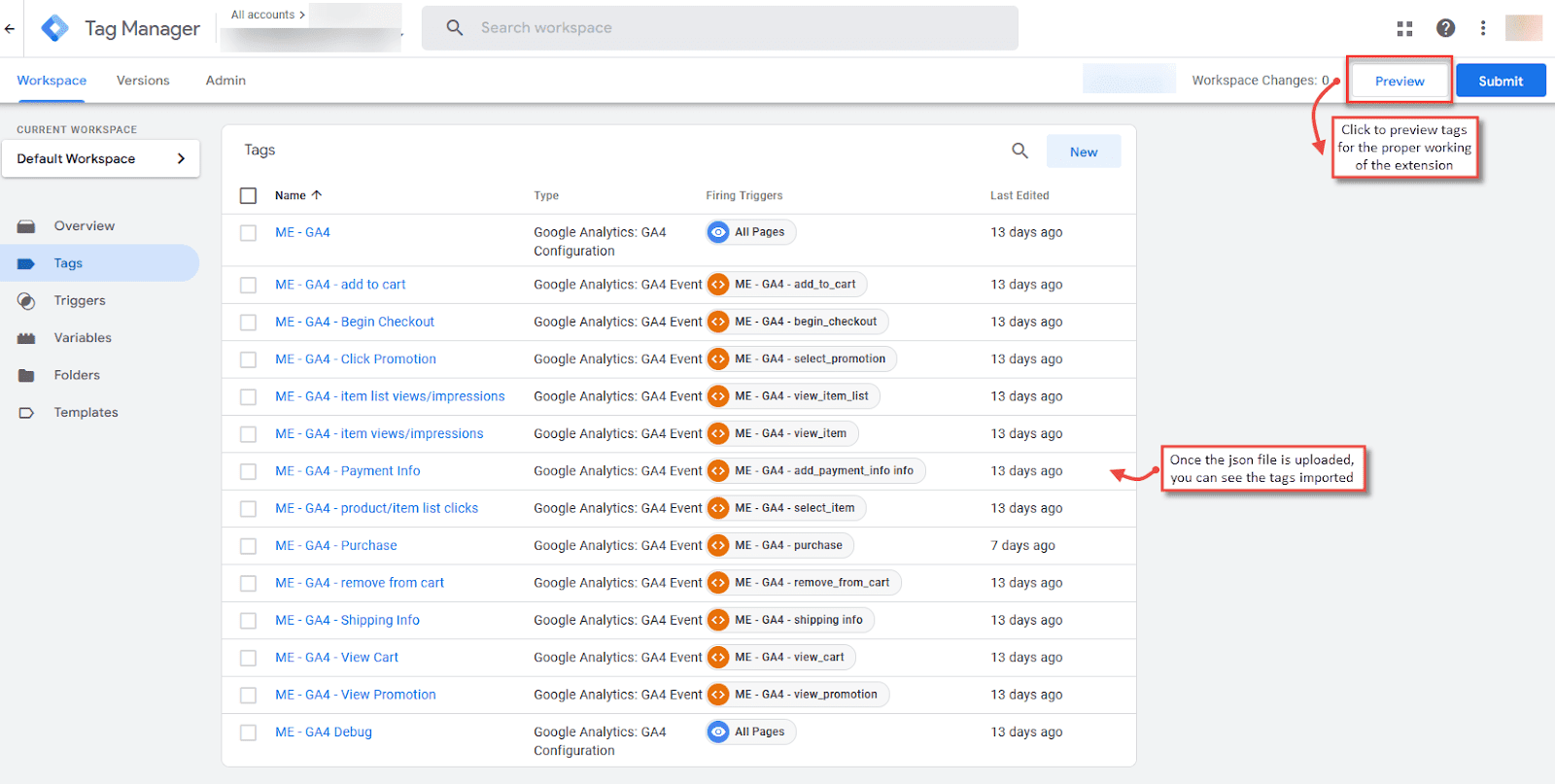
And in this way, you can setup GA4 for your Magento 2 store. And in this way, you can setup GA4 for your Magento 2 store. The GA4 dashboard will immediately start collecting information.
Bonus Tip: Magento 2 GA4 eCommerce Tracking
- Define and set goals for each campaign/event to ensure your page is achieving certain goals and whether there are any specific actions you need to take in the future.
- Since GA4 focuses heavily on event tracking, take advantage of this opportunity to do so create customized events it may be important for your business. If you run any offer, you can create appropriate events to track its progress.
- Re-engage with your potential customers using remarketing. You can create ads for users who have previously interacted with your Magento 2 store and pique their interest again.
- Take advantage of advanced GA4 reporting such as funnel exploration and path exploration to understand user flows and how they interact with your Magento store.
- Link important Google accountsespecially Google Ads accounts such as Ad Manager, Google AdSense, and Google Ads, which will help you stay up to date.
Final Thoughts
And that’s the summary of enhanced Magento 2 GA4 eCommerce tracking.
We hope this blog helps you better understand GA4 for your Magento 2 store and how to set it up.
Analyzing your customers’ behavior and creating actionable strategies is what drives results.
Make the most of this feature and improve your store performance. Good luck in scaling your eCommerce store!
Frequently Asked Questions
1. What replaces Google Analytics 4?
Google Analytics has replaced Google’s Universal Analytics version.
2. Does Magento 2 support Google Analytics 4?
Yes, Magento 2 supports Google Analytics 4.
3. What is GA4 eCommerce tracking?
GA4 eCommerce Tracking tracks and gives you insightful data on various eCommerce events such as product views, add to cart items, checkout processes, and more.
Agen Togel Terpercaya
Bandar Togel
Sabung Ayam Online
Berita Terkini
Artikel Terbaru
Berita Terbaru
Penerbangan
Berita Politik
Berita Politik
Software
Software Download
Download Aplikasi
Berita Terkini
News
Jasa PBN
Jasa Artikel
News
Breaking News
Berita
Comments are closed, but trackbacks and pingbacks are open.